



Food show planning is the year-round process a distributor uses to prepare, run, and measure the food show it hosts for its operator customers. The strongest distributors treat it as a 12-month cycle: debrief last year's show in Q2, build the supplier marketing catalog in Q3, lock supplier commitments in Q4, execute the show in spring, and measure the return afterward. Planned this way, a food show becomes a predictable profit driver instead of an annual scramble.
This is the complete guide to food show planning for distributors: what it is, when to start, the full 12-month timeline, a planning checklist by category, and how to tell whether the show paid off. It is the hub for our deeper posts on each stage, so use it as your map and follow the links for the detail.
Key takeaways
- Food show planning is a 12-month cycle, not a season. The best distributors start the next show right after the last one ends.
- The annual arc: Q2 debrief and database cleanup, Q3 marketing catalog, Q4 supplier negotiations, spring execution, and post-show measurement.
- A food show a distributor hosts is a selling event for its operators, different from a trade show a company exhibits at.
- Planning is cross-functional. Sales, marketing, procurement, and operations all own a piece, and one person should coordinate them.
- The investment is real, and so is the return. At one Meal Ticket customer, Wagner Food Service, a single show drove 800 new-to-customer cases and 5,000 product likes in five hours.
What is food show planning, and why does it matter?
Food show planning is the process of preparing, promoting, running, and measuring a distributor-hosted food show, managed as a year-round cycle rather than a few frantic months before the event. It matters because a food show is one of the largest discretionary investments a distributor makes each year, and the return depends almost entirely on how far ahead the work starts.
A distributor's food show is a selling event. You are gathering your operator customers in one room to taste new products, meet your supplier partners, and commit to cases. That is different from a trade show a company travels to and exhibits at. Here, you are the host, and the quality of the show is the quality of your planning.
When should distributors start planning a food show?
Distributors should start planning their next food show in Q2 of the prior year, right after the spring show wraps, while the last event is still fresh and contacts are warm. Starting this early is the single biggest predictor of a strong show.
The full case for Q2, the reasons it works, and what you risk by waiting, lives in its own guide: why successful distributors start planning in Q2 of the prior year. Read it for the detail. For this guide, Q2 is simply where the 12-month cycle below begins.
What does a 12-month food show planning timeline look like?
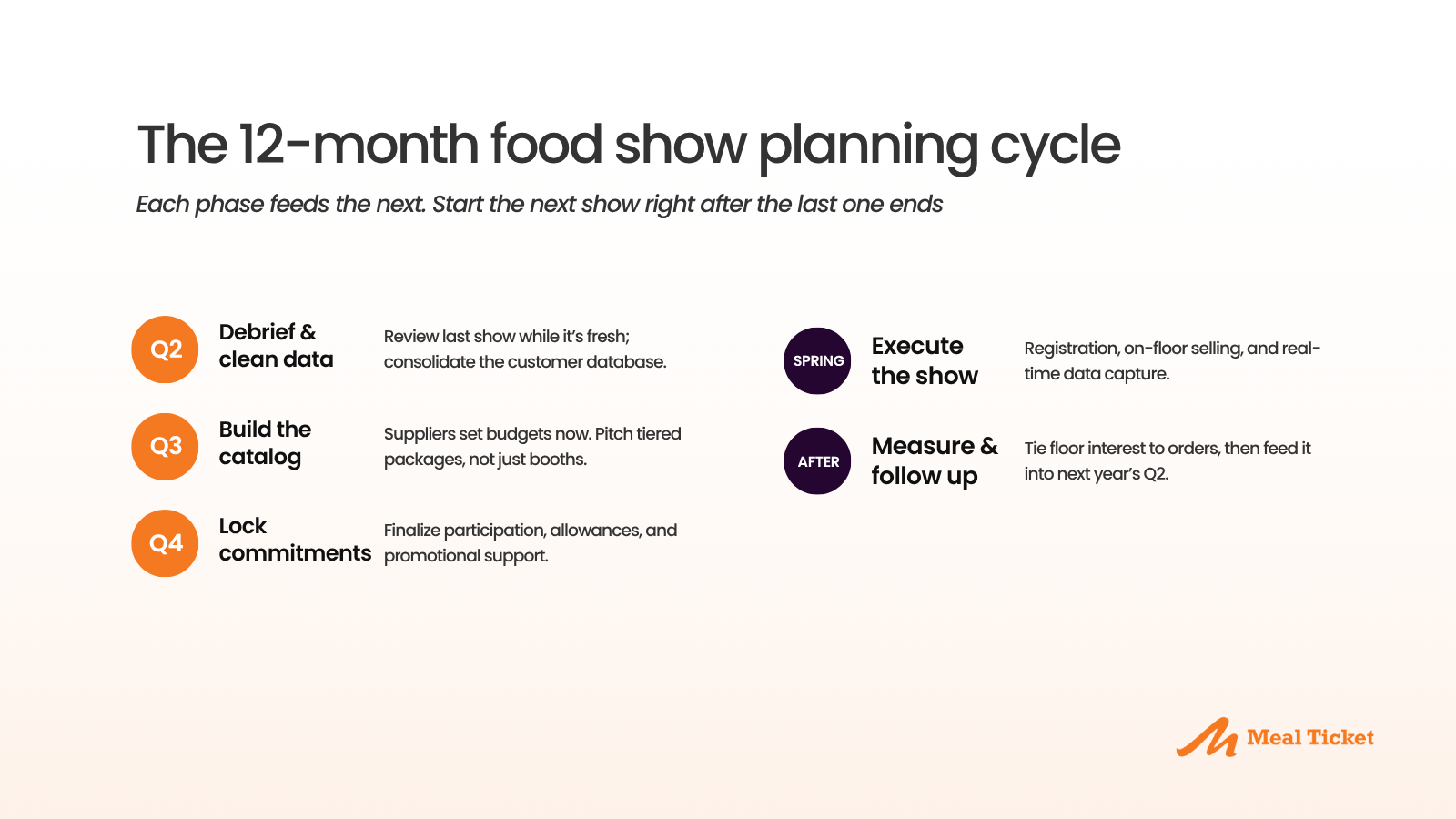
A 12-month food show planning timeline runs in five phases: a Q2 debrief and database cleanup, a Q3 marketing catalog build, Q4 supplier negotiations, spring show execution, and post-show measurement. Each phase feeds the next, so work done early compounds into a smoother, more profitable event.
Q2: Debrief and clean your database
Start with the post-show debrief while the last event is fresh: what worked, what missed, which customers you failed to reach. Then clean and consolidate your customer data, because segmented invitations for next year are only as good as the database behind them. This is the foundation the rest of the year is built on.
Q3: Build the supplier marketing catalog
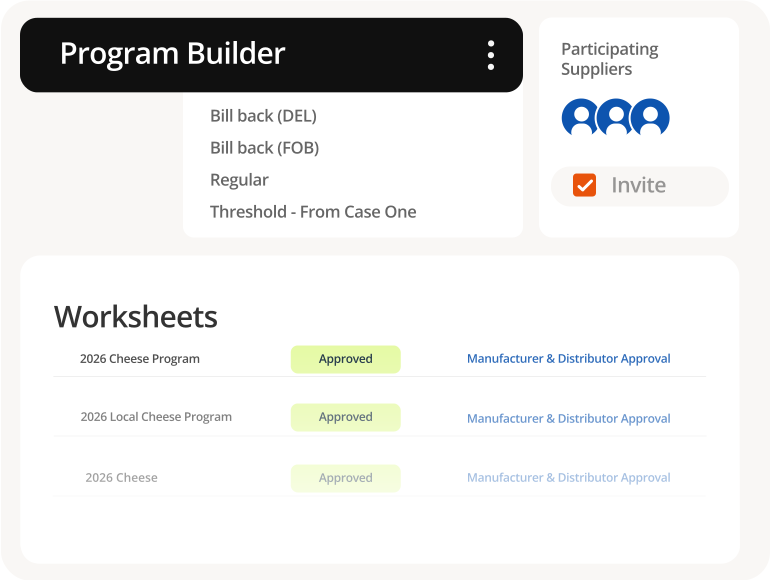
Q3 is when most suppliers finalize their budgets, which makes it the window to build and pitch your marketing plan. Decide what your show will be: basic booth fees, or tiered packages with premium placement, pre-show promos, and post-show campaigns. This is where you turn the food show into a year-round revenue engine by bundling supplier participation into a real catalog.
Q4: Lock supplier commitments
Q4 is the negotiation quarter. You sit down with suppliers to finalize participation, allowances, and promotional support for the coming show. Securing these commitments now, in writing, is what funds the deals that drive case sales on the floor.
Spring: Execute the show
Spring is show time. Registration, on-floor selling, sample tracking, and real-time data capture all happen here. The goal is a smooth VIP experience for your operators and a clean record of every case sale, product like, and allowance so nothing gets lost in the noise of the day.
After the show: Measure and follow up
The weeks after the show are where its value is realized. Run a structured debrief, follow up on the leads and product interest you captured, and turn floor commitments into booked orders. Start here with the five post-show questions every distributor should ask, then feed what you learn straight into next year's Q2.
What belongs on a food show planning checklist?
A food show planning checklist covers five categories: venue and logistics, vendors and suppliers, marketing and invitations, technology, and follow-up. Working from a categorized checklist keeps the cross-functional pieces from falling between departments as the event approaches.
Venue and logistics
Book the venue early, and plan floor layout, booth placement, traffic flow, AV, catering, and signage. These are the items with the least flexibility as the calendar fills, so they belong at the front of the process.
Vendors and suppliers
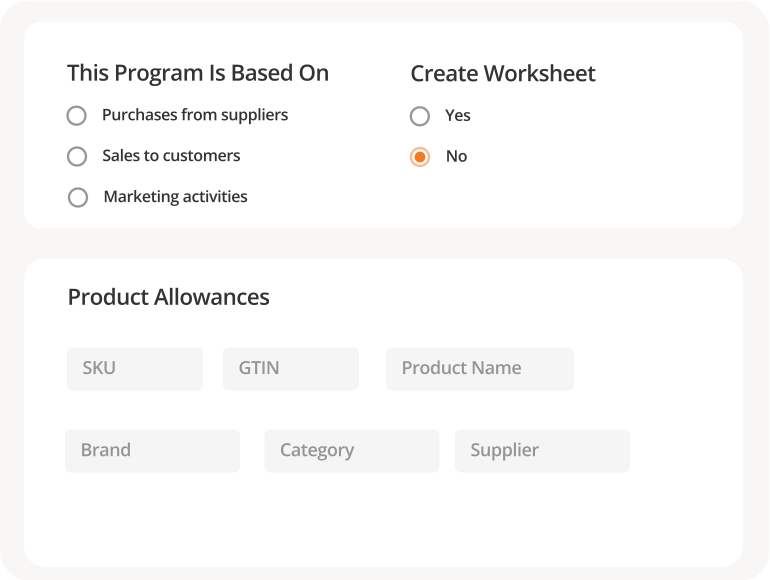
Confirm which suppliers are participating, at which package tier, and what allowances and samples they are bringing. Track every commitment in one place so nothing agreed to in Q4 is forgotten by spring.
Marketing and invitations
Build segmented invitations from your customer database, promote the show early and more than once, and prepare the show catalog and any pre-show campaigns. Invite by account value and buying behavior, not just each rep's personal list.
Technology
Decide how you will handle registration, on-floor engagement, sample and order capture, and analytics. Manual sign-in sheets and paper show books do not survive a busy floor, which is why distributors move to purpose-built tools. See the features a trade show platform needs for what to look for.
Follow-up
Plan the post-show follow-up before the show, not after. Decide who owns lead follow-up, how you will tie floor interest to orders, and when you will run the debrief. The distributors who plan follow-up in advance are the ones who actually collect on the show.
How do you know if your food show paid off?
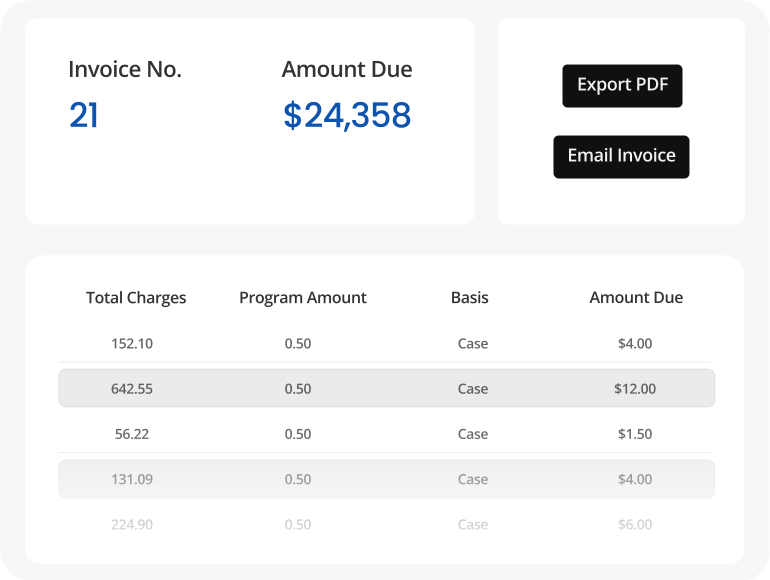
You know a food show paid off by measuring it in profit and follow-through, not foot traffic. Compare the show-attributable gross profit against the cost of running it, and track metrics like new-to-customer case sales, product interest, allowance commitments, and post-show reorders. A busy floor that never converts to reorders is activity, not ROI.
Measurement is the step most planning stops short of, and it is what makes next year's plan smarter. The proof that it is worth doing well: at one Meal Ticket customer, Wagner Food Service, a single show drove 800 new-to-customer cases and 5,000 product likes in a five-hour window, all captured cleanly enough to act on.
For the full method, including the six metrics and the ROI formula, see how to measure food show ROI.
Frequently asked questions
How long does it take to plan a food show?
Most distributors plan on a roughly 12-month cycle, starting the next show soon after the last one ends. The heaviest work runs from Q2 of the prior year through the spring event.
Treating it as a full-year process, rather than a few months of scramble, is what separates strong shows from stressful ones and gives you room to secure the best venues and supplier terms.
What is the difference between a food show and a trade show?
A distributor-hosted food show is an event the distributor runs for its own operator customers to drive case sales, with suppliers exhibiting products to taste and order. A trade show is usually a larger industry event a company attends or exhibits at to reach a broad audience.
Food shows are among the most tactile selling environments in foodservice, because buyers are there to taste and write orders. A related but different event is a buying group show, where the distributor is the buyer meeting manufacturers.
Who should be involved in food show planning?
Food show planning is cross-functional: sales owns customer invitations and on-floor selling, marketing owns promotion and the show catalog, procurement manages supplier participation and allowances, and operations handles venue and logistics.
A single owner should coordinate across all of them, because the most common planning failures happen in the handoffs between departments, not inside any one of them.
How much does it cost to run a food show?
Cost varies widely with size, venue, and format, so there is no single number. Budget the major line items early: venue, staffing and overtime, printing, samples, technology, and travel.
The more useful question is not what a show costs, but whether the case sales and supplier commitments it generates clear that cost, which is why measurement matters as much as budgeting.
What is the best time of year to hold a food show?
Many distributors hold food shows in the spring, which sets the planning cycle in motion the prior Q2. The best timing depends on your operators' buying calendar and your suppliers' program years.
Choose a date that lets customers commit to programs they can act on for the rest of the year, so the show drives buying well beyond the day itself.
How do you get more operators to attend a food show?
Drive attendance with targeted, segmented invitations built from a clean customer database, not just each rep's personal network. Invite by account value and buying behavior, promote early and more than once, and make registration fast.
Tracking who registers and attends also tells you which outreach worked, so each year's invitations get sharper than the last.