


To measure food show ROI, compare the gross profit your show generated against what it cost to run, then track the six metrics that show where that value came from: new-to-customer case sales, product interest captured, supplier allowance commitments, attendance by segment, post-show reorder lift, and cost per new case. Revenue alone is not ROI. On thin distribution margins, you measure a food show in profit and follow-through, not foot traffic.
Most distributors can tell you their food show felt busy. Far fewer can tell you what it earned. This is the measurement side of the food show most planning guides skip, with the six numbers that separate a successful show from an expensive one.
Key takeaways
- Food show ROI is show-attributable gross profit minus the cost of the show, divided by that cost. Measure in profit, not revenue.
- Track six metrics: new-to-customer case sales, product interest captured, allowance commitments, attendance by segment, post-show reorder lift, and cost per new case.
- Much of the return arrives after the event. On-floor interest only counts once it becomes repeat orders.
- Real numbers are possible. At one Meal Ticket customer, Wagner Food Service, a single show drove 800 new-to-customer cases and 5,000 product likes in a five-hour window.
- Thin margins are why profit is the unit. IFDA puts the median foodservice distributor net profit at 2.9%, so a show has to clear its cost in earned margin, not gross sales.
What is food show ROI, and why measure it?
Food show ROI is the return a distributor earns on the money and time it puts into hosting a food show, measured as show-attributable gross profit minus the total cost of the show, divided by that cost. Measuring it matters because a food show is one of the largest discretionary investments a distributor makes each year, and without measurement, you are repeating a big bet on feel alone.
A food show is different from a trade show a company attends to collect leads. As the host, you are not fishing for prospects. You are driving your existing operators to commit to cases, sample new items, and lock in the programs that carry your margin. That means the return shows up as orders and allowances, not business cards.
Measurement also closes the loop on the rest of your planning. The qualitative debrief that pairs with these numbers tells you what felt right and wrong about the show. The metrics below tell you whether it actually paid. You want both, and they answer different questions.
How do you calculate food show ROI?
Calculate food show ROI with a simple formula: subtract the total cost of the show from the gross profit you can attribute to it, then divide by that total cost. Written out, food show ROI = (show-attributable gross profit minus total show cost) divided by total show cost. Use gross profit, not revenue, because a case sold at a thin margin returns far less than its sticker price suggests.
Two inputs decide whether this number is honest.
Total show cost is everything: venue, staffing and overtime, printing, samples, technology, travel, and the hours your team spent planning. Distributors routinely undercount the labor, which flatters the result.
Show-attributable gross profit is the margin on orders you can actually trace to the show. That is the hard part, and it is where measurement lives or dies. If you cannot connect a post-show order back to a customer who engaged at the event, you cannot claim it, and most of your real return goes uncounted.
Why gross profit instead of revenue? Because distribution runs on thin margins. With median foodservice distributor net profit at 2.9%, according to IFDA, a show that moved a lot of low-margin cases can look enormous in revenue and still lose money once you net out its cost. Revenue measures noise. Profit measures the show.
What are the six metrics that prove a food show paid off?
The ROI number is the headline. These six metrics are the story behind it, and each one is something you can capture at the show or in the weeks after.
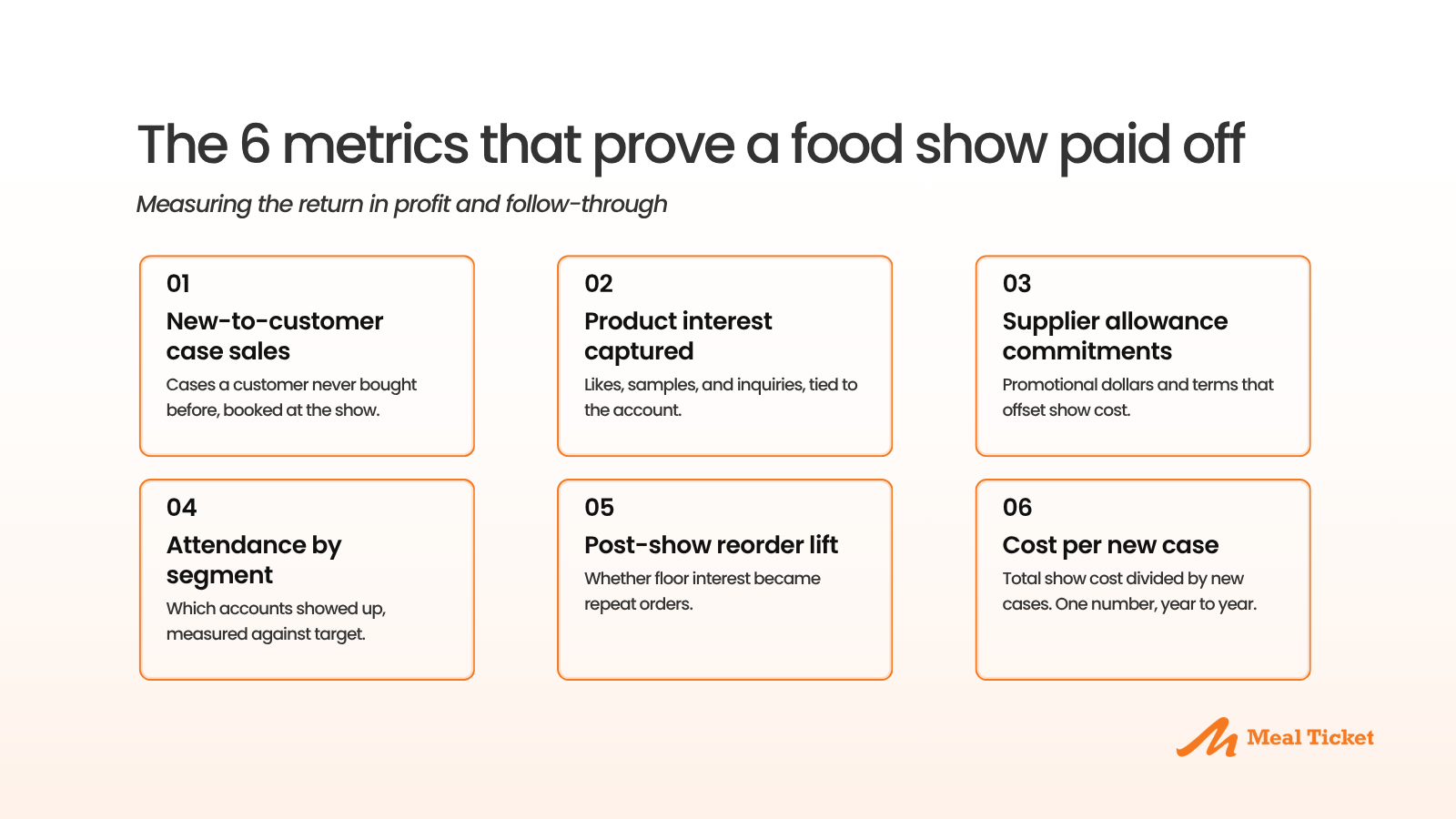
New-to-customer case sales
New-to-customer case sales count the cases of products a customer had never bought before but committed to at the show. This is the clearest signal a food show worked, because it is growth you can trace directly to the event.
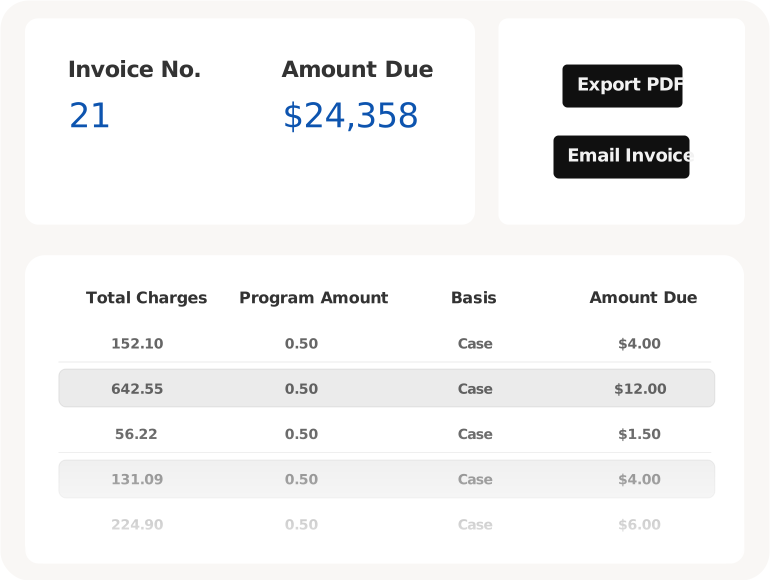
This is the metric that makes the case for the whole show. When Wagner Food Service ran a show on the Meal Ticket platform, it drove 800 new-to-customer cases from a single event. That is not attendance or interest. That is new volume, booked, that did not exist before the floor opened.
Product interest captured
Product interest captured measures how many products drew engagement at the show through likes, sample requests, and inquiries. It is your leading indicator, the pool of intent that reorders and new-item adoption flow out of later.
The same Wagner show logged 5,000 product likes in a five-hour window. Interest at that scale only pays off if you capture it cleanly, tied to the customer who expressed it, so your team can follow up on the right items with the right accounts. Digital capture beats a stack of paper sign-in sheets, which is one reason distributors move to trade show technology that records interest by item and account.
Supplier allowance commitments
Supplier allowance commitments track the promotional dollars and deal terms suppliers agree to in connection with the show. These are earned income, and they belong in your ROI because they offset show cost and fund the deals that drive case sales.
A food show is a two-sided event. Operators commit to cases, and suppliers commit to allowances and promotional support to make those cases move. Counting only the operator side undersells the return. If you are already monetizing supplier participation in your food show program, those commitments are a direct line on your ROI.
Attendance by customer segment
Attendance by customer segment measures not just how many operators showed up, but which ones, against the targets you set. A show packed with low-value walk-ins is a different result from one that drew your top accounts and your priority prospects.
Raw attendance flatters. Segmented attendance informs. Track turnout against the invitation list by account value and segment, so you can see whether the operators you most needed in the room actually came, and adjust next year's outreach accordingly.
Post-show reorder lift
Post-show reorder lift measures whether products sampled or promoted at the show became repeat purchases in the following weeks. It is the single most important metric for real ROI, because a show that sparks interest but no reorders produced excitement, not earnings.
This is where most measurement stops too early. The cases booked on the floor are only part of the return. The rest is the operator who tasted a new item, added it to the next order, and kept buying it. If you stop counting the day the show ends, you miss the part of the return that compounds.
Cost per new case and overall ROI
Cost per new case divides total show cost by the number of new-to-customer cases the show produced, giving you a single, comparable efficiency number. Paired with the overall ROI ratio, it tells you whether this show was more or less productive than the last one.
One clean figure you can carry year to year beats a folder of anecdotes. Cost per new case lets you compare shows, venues, and formats on the same footing, and it turns "the show felt good" into a number you can actually manage.
When should you measure food show ROI?
Measure food show ROI in three passes: live during the event, immediately after, and again once reorders have had time to land. On-floor metrics like case sales, product interest, and attendance are captured in real time. Reorder lift and final ROI need weeks of follow-through before the number is real.
Measuring once, the week after the show, is the most common way distributors understate their own results. The floor numbers are in by then, but the reorders are not. Set a schedule: capture live data at the event, close the books on direct show sales within a week, and run the full ROI calculation after at least one reorder cycle. The same early-and-structured discipline that makes food show planning work applies to measuring it.
How do you improve food show ROI next year?
Improve food show ROI by feeding this year's six metrics into next year's plan: invite more of the segments that reordered, promote the products that converted, re-invite the suppliers whose allowances paid off, and cut what did not move. Measurement is only worth doing if it changes the next show.
The distributors who compound their food show returns treat each event as an experiment with a scorecard. The metrics tell you which products, segments, and supplier partners earned their place on the floor, and which were expensive to host. Do that for two or three cycles and your show stops being an annual guess and becomes a predictable profit center.
Frequently asked questions
What is a good food show ROI?
There is no universal benchmark for a good food show ROI. Measure your show against its own cost and last year's result: it has paid off when the gross profit you can attribute to it clears the cost of running it, and improves year over year.
Comparing to your own history is far more useful than chasing an industry average, because show cost, format, and customer base vary too much between distributors for a single number to mean much.
How do distributors attribute sales back to a food show?
Attribute sales by capturing who attended and what they showed interest in, then tagging their post-show orders against that list. A CRM or trade show platform that links registration and on-floor activity to order data makes this automatic.
Without that connection, attribution becomes a manual reconciliation weeks later, which is why so much show-driven revenue goes uncounted.
What data should you capture during a food show?
Capture attendance by customer and segment, product likes and sample requests, allowance commitments from suppliers, and new-to-customer orders placed on the floor. The goal is a clean, connected record you can tie back to orders later.
Paper sign-in sheets and memory do not survive contact with a busy show floor, so the capture method matters as much as the list.
How long should you track food show reorders?
Track post-show orders through at least one full reorder cycle, not just the days right after the event. Much of a food show's real value shows up later, when on-floor interest becomes repeat orders.
Cutting off measurement too early is the fastest way to understate a show that actually worked.
Do you need software to measure food show ROI?
You can measure basic food show ROI in a spreadsheet, but attribution gets hard fast when registration, product interest, and order data live in separate systems. A trade show platform that connects them turns the six metrics into a report rather than a reconciliation project.
The more of your show you want to measure, the more the connected-data approach pays for itself.
What is the most common food show ROI mistake?
The most common mistake is judging a food show by revenue or foot traffic instead of profit and follow-through. A busy floor that never converts to reorders is activity, not ROI.
Thin distribution margins make the difference matter: a show can move impressive volume and still lose money once you net out its cost.
Maximize trade show success by easily planning, running, and reporting on trade show performance with TrackMax+, by Meal Ticket. Book a demo today.