



Why food distributors keep losing money they've already earned
Rebate leakage happens when distributors qualify for supplier rebates and allowances, but never collect the full amount – usually because programs are tracked by hand across spreadsheets and ERP systems that weren't built for this level of complexity. Distributors who consolidate that data into one platform typically recover 2-3% more in purchase rebate income and cut leakage by 2%.
Somewhere in your rebate program right now, there's money you already earned sitting uncollected. Not revenue you're waiting on. Not a receivable aging out. Money a supplier owes you for volume you already shipped, buried in a spreadsheet cell that nobody double-checked this quarter.
That's rebate leakage. It doesn't show up as a mistake. It shows up as a slightly smaller check, month after month, until somebody finally adds it all up.
What is rebate leakage, and why does it keep happening?
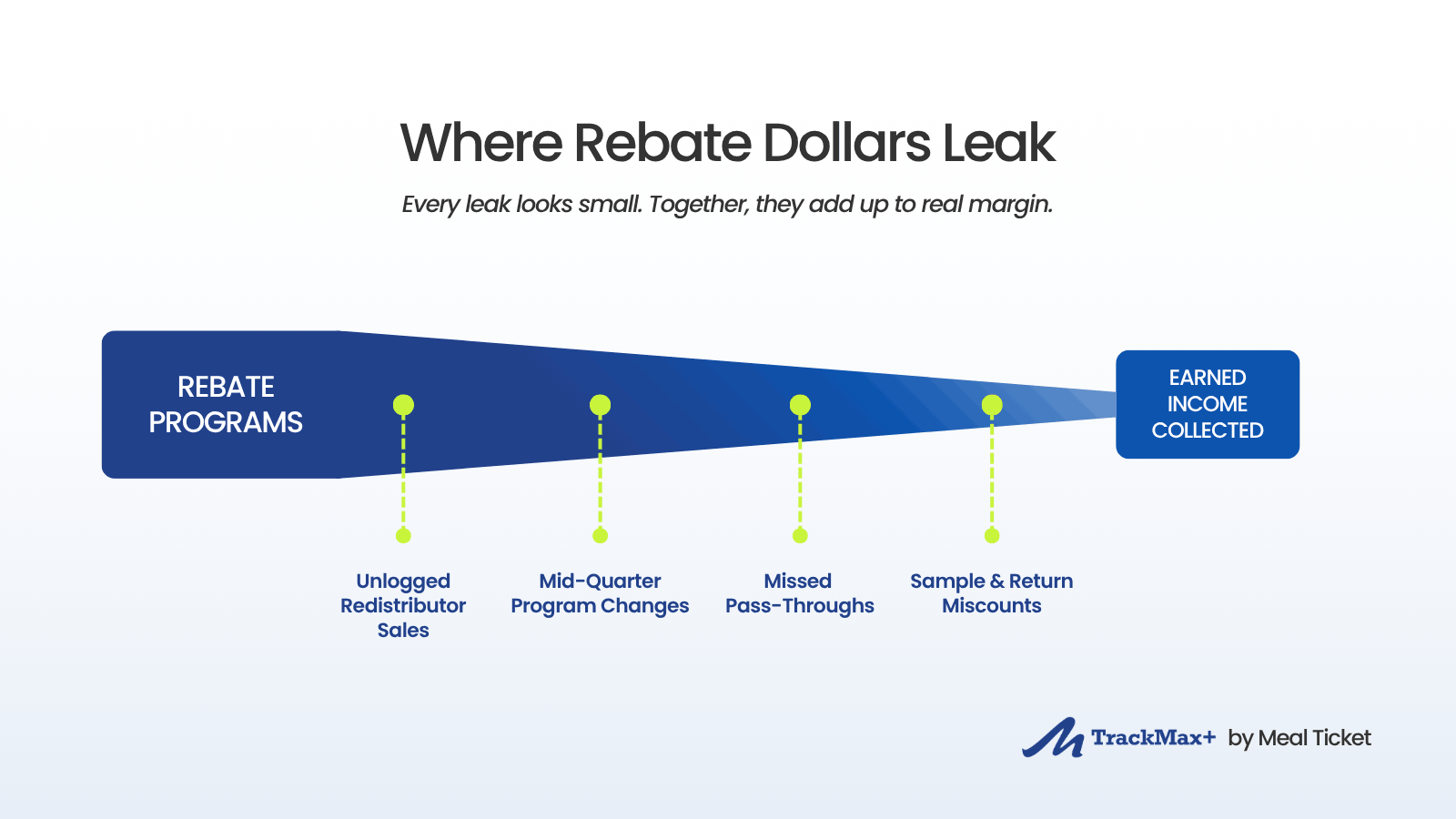
Rebate leakage is earned income that a distributor qualifies for but never collects. A redistributor sale that never got logged. A new item that a supplier quietly added to a program mid-quarter. A pass-through nobody flagged, or a sample or a return that threw off the count.
It keeps happening because most distributors are still running rebate programs the way they did a decade ago: by hand, in a spreadsheet, cross-checked against an ERP system that was never built for this kind of complexity. For the complete picture of how these programs work and how distributors keep every dollar, see what foodservice rebate management involves.
ERPs are good at posting a journal entry. They are not built to track:
- SLA exemptions, applied program by program
- Buying group clawbacks
- Multi-supplier programs with different terms on the same SKU
- Pass-throughs that change mid-contract
So the tracking falls to whoever has the patience for a spreadsheet with forty tabs. That person eventually moves on. The spreadsheet doesn't go with them, and neither does the context for why row 214 says what it says.
Why does the whole foodservice supply chain lose money?
Rebates are just the most visible leak. The same pattern shows up everywhere a distributor touches a supplier or a customer.
Allowance negotiations happen over email and phone, then get typed into another spreadsheet. Trade show management still runs on paper showbooks, and whoever remembers what was promised at booth 14.
Sales and marketing data live in a CRM that doesn't talk to the rebate system, so nobody can say with real confidence which promotion actually moved product. And distributors have less room to absorb any of it: tariffs and rising supplier costs are already squeezing margins that were thin to begin with.
None of these is a separate problem. They're the same problem in different clothes: the tools don't talk to each other, so the data doesn't either, and distributors end up reconstructing the truth after the fact instead of seeing it in real time.
What would it actually take to stop it?
Not more spreadsheets. Not another point solution bolted onto the last one.
Stopping the leak means putting sales data, purchase data, and program data in one place instead of three or four. It means invoicing and reconciliation that happen automatically, so a vendor receivable doesn't sit open for months because nobody has had a free afternoon to chase it. It means allowance negotiations, trade show commitments, and supplier programs living in the same system, so a promise made at a food show in April doesn't get lost by the time the invoice is due in July.
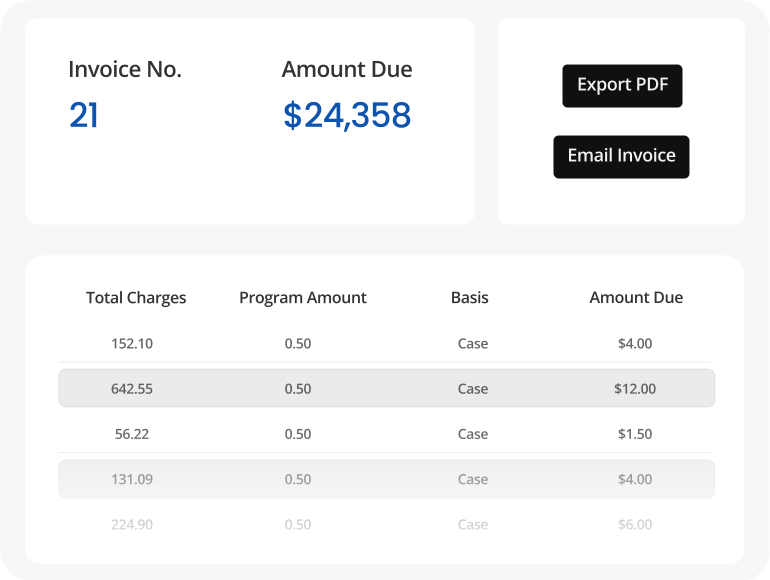
Distributors who get there don't just save time. On average, they increase purchase rebate income by 2 to 3% and cut leakage by up to 2%, largely by consolidating data they already have instead of hunting for it every month. Vendor receivable cycles that used to run 90 days can shrink to less than a week once the invoicing is automatic instead of manual.
That's not a hypothetical. It's what happens when the pieces get unified. Getting there took a while, though, even for the company that builds the software.
How Meal Ticket got here: three decades of fixing the rebate problem
Trackmax has tracked distributor rebates for 25 years – long before anyone was calling this category "SaaS" at a food show. Meal Ticket acquired Trackmax and built on that foundation, adding pieces as new problems surfaced: insights and reporting, trade show management, and a CRM built specifically for food distribution.
Each piece solved a real problem on its own. But stitched together one at a time, they started to resemble the exact thing they were built to fix, just one level up. A distributor might log into one tool for rebates, another for trade shows, and a third for sales data, with none of them sharing a login, let alone a source of truth.
The same fragmentation was hitting the other side of the supply chain at the same time. Restaurant operators were tracking food costs, inventory, and menu profitability across the same tangle of spreadsheets and disconnected POS systems that were draining distributor margin. That's what MarketMan, by Meal Ticket, was built to fix: an AI-powered restaurant inventory management platform now used by more than 15,000 restaurant locations across 55+ countries to keep food costs and menu profitability visible in one place.
Two sides of the same supply chain. Two different sets of tools solving the same underlying margin problem.
One company, two platforms built for foodservice
That's the shape Meal Ticket has settled into: one company, organized around the multiple sides of the foodservice supply chain that need this kind of visibility: distributors, suppliers, and restaurant operators.
MarketMan handles the operator's side: food costs, purchasing, recipe costing, and menu profitability, integrated with POS and accounting systems.
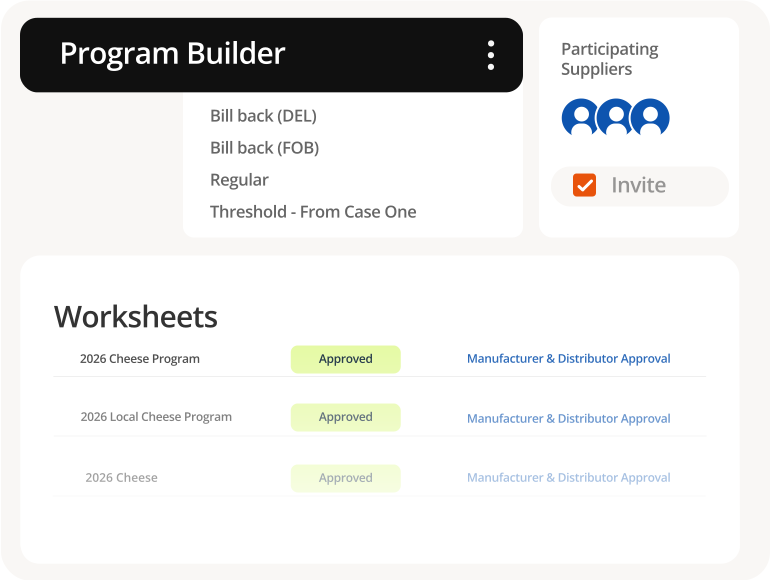
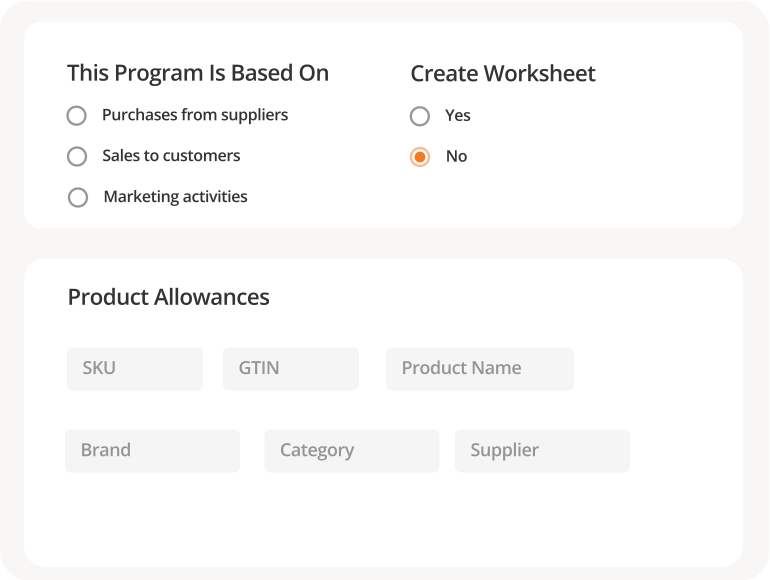
TrackMax+, is the answer on the distributor's side. Launched in April 2026, the distributor profitability management platform brings rebate and allowance management, distributor insights, trade show management, sales prospecting, and marketing into one platform instead of five. Distributors get a complete decision intelligence platform with a single login, one source of truth for sales and program data, and the same automated invoicing and reconciliation that shortens that 90-day vendor receivable cycle down to about a week.
Meal Ticket processes more than $40 billion in annual sales and rebate volume for nearly 400 distributors and suppliers. It isn't a new company showing up with a pitch. It's the same rebate-tracking foundation distributors have relied on for 25 years, rebuilt as an end-to-end profitability management platform, on the idea that a distributor shouldn't need five logins to answer one question: how much money have we actually earned?
What this means if you're running a distribution business today
If your team is still reconciling rebates in a spreadsheet, chasing a supplier for a check that should have arrived months ago, or negotiating allowances over email and hoping someone remembers to write it down, none of that is a personal failing. It's what happens when the tools weren't built to keep up with how complex these programs actually are.
The fix isn't a new habit. It's a platform that already has the data in one place. If you want to see what that looks like day to day, TrackMax+ and MarketMan are both worth a closer look – whichever side of the supply chain you're running. Run your numbers through the TrackMax+ ROI calculator and find out what's sitting uncollected right now. See what you're leaving on the table.
Frequently asked questions
What is TrackMax+?
TrackMax+, by Meal Ticket, is the end-to-end distributor profitability management platform for food distributors. It brings rebate and allowance management, distributor insights, trade show management, sales prospecting, and marketing into a single platform.
What is rebate leakage?
Rebate leakage is earned income a distributor qualifies for under a supplier program but never collects, usually because of missed redistributor sales, mid-contract program changes, unflagged pass-throughs, or manual tracking errors.
How is TrackMax+ different from the original Trackmax?
TrackMax+ keeps the rebate and allowance tracking distributors have relied on for 25 years, and adds a shared login across Meal Ticket products, built-in allowance negotiation workflows, multi-supplier programs, and connections to trade show and CRM data that used to live in separate systems.
What's the difference between TrackMax+ and MarketMan?
TrackMax+ serves food distributors managing rebates, allowances, and supplier programs. MarketMan serves restaurant operators managing food costs, inventory, and menu profitability. Both are part of the Meal Ticket family.
Who is Meal Ticket?
Meal Ticket is a software provider in the foodservice supply chain, delivering profitability management for distributors, suppliers, and restaurant operators through two platforms: TrackMax+ and MarketMan.