


Food distributors make money two ways at once: a thin margin on the products they buy and resell, and back-end earned income from supplier programs like rebates and allowances. The selling margin alone is slim, because foodservice is high-volume and fiercely price-competitive. The food distributor profit margin is one of the thinnest in any industry, so the programs on the back end are not a bonus. For many distributors, they are a large share of the profit, which is why understanding both engines matters.
This is the guide to how food distribution actually makes money: the real margin numbers, why rebates carry so much of the P&L, which categories are most profitable, and the levers that move the bottom line. It is the hub for our deeper posts on distributor profitability.
Key takeaways
- Distributors make money on two engines: a thin distribution margin plus back-end earned income from supplier programs.
- Net margins are razor-thin, among the lowest of any industry, so the business runs on volume and earned income.
- Because the selling margin is so thin, rebates and allowances carry a large share of bottom-line profit.
- Profitability varies by category. Commodity center-of-the-plate items are low-margin; specialty and value-add products carry richer programs.
- The most controllable profit lever for most distributors is capturing earned income they already generate, not chasing new sales.
How do food distributors make money?
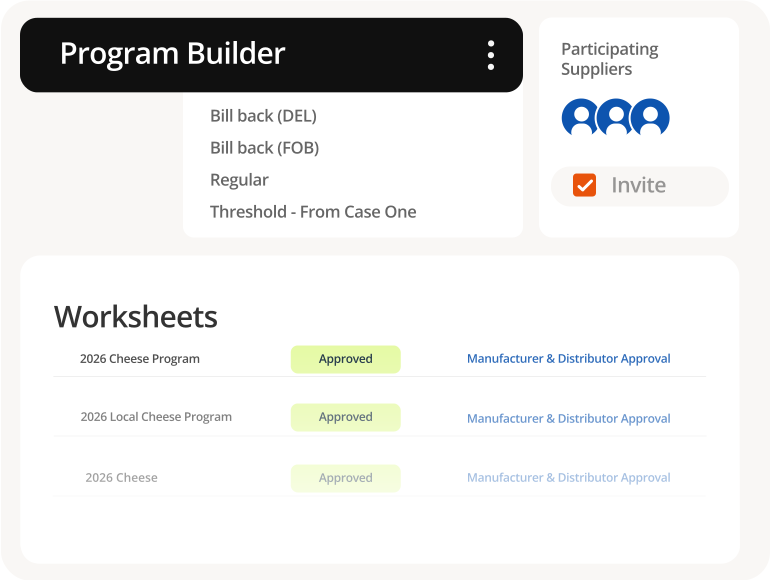
Food distributors make money on two engines. The first is the distribution margin: buying products from suppliers and reselling them to operators at a markup that covers warehousing, delivery, and overhead. The second is back-end earned income: rebates, allowances, and program dollars paid by suppliers based on what the distributor purchases and promotes. On thin selling margins, the second engine often carries much of the profit.
Think of it as two income statements stacked on top of each other. The front end is the classic distribution business: move cases, manage trucks, keep warehouses full. The back end is the program business: earn income from suppliers for the volume and growth you drive.
Most people outside the industry only see the first engine and assume distributors get rich on markup. The reality is the opposite. The markup is thin, and the program income is where a large part of the real profit lives.
Why is the food distributor profit margin so thin?
The food distributor profit margin is thin because foodservice is high-volume, commoditized, and fiercely price-competitive, so operators switch over small price differences. Gross margins are modest to begin with, and warehousing, delivery, fuel, and labor consume most of what is left before it reaches the bottom line. What survives as net profit is a razor-thin sliver, which is why distributors run on volume and lean on earned income.
The business is built on volume, not markup. When each dollar of sales returns only a sliver of profit, scale and efficiency are survival, not strategy.
This is the reality that reframes everything else in this guide. When the whole business nets so little on each dollar, anything that adds to earned income or trims cost has an outsized effect on profit.
Why do rebates and earned income matter so much to distributor profit?
Rebates and earned income matter because, on such thin net margins, they represent a large share of what a distributor actually keeps. Meal Ticket's analysis of distributor programs puts back-end earned income at roughly 40% to 90% of a distributor's bottom-line profitability. When that much of your profit comes from supplier programs, collecting all of it is not optional.
This is the insight that separates distributors who understand their own economics from those who do not. If most of your profit is earned on the back end, then the discipline of tracking and collecting every rebate dollar is not a finance chore. It is core to the business model.
It is also why earned income that leaks is so damaging. A dollar of rebate you fail to collect is a dollar of near-pure profit gone, because you already did the work to earn it. Managing that well is the subject of foodservice rebate management, the companion to this guide.
Which product categories are most profitable for distributors?
Profitability varies sharply by category. Commodity center-of-the-plate items, like proteins, move high volume at thin margins and modest program rates. Specialty, value-add, and non-food categories carry richer rebates and stronger growth incentives. In Meal Ticket's analysis, program rates on center-of-the-plate run in the low single digits, while specialty and value-add categories can reach double digits.
The practical consequence shows up on the sales floor. When reps push whatever moves easily, they often push high-volume, low-margin commodities and leave richer categories underdeveloped.
A distributor that understands its category economics can steer the mix: coach reps toward the categories that actually build profit, and negotiate harder on the programs that matter most. Selling blind to program value is how thin margins get thinner.
How can distributors improve their profit margin?
Distributors improve their profit margin through three levers: capture more of the earned income they already generate, shift the sales mix toward higher-margin categories, and cut the operating costs between gross and net margin. Of the three, capturing earned income is usually the fastest, because the money has already been earned and only needs to be collected.
On margins this thin, small gains compound, so the order you pull these levers matters.
Capture more earned income
Recovering rebate dollars that would otherwise leak flows almost straight to the bottom line, often with more impact than an equivalent push for new sales. It is the fastest lever, because the money already exists on the books, waiting to be collected. That is why earned income lost to manual tracking is worth taking seriously.
hift the sales mix
Steering reps toward higher-margin categories lifts profitability over time, but it moves slowly. It takes quarters of coaching and customer conversations to change what a whole book of business buys.
Cut operating costs
Trimming the warehousing, delivery, and labor costs between gross and net margin protects profit, but it runs into fixed realities like trucks, fuel, and routes. Efficiency helps at the edges; it rarely transforms the number.
The distributors who protect their margins share one habit: they can see their true profitability by product, customer, and program, and they act on it. That visibility is what TrackMax+ is built to provide. You cannot manage a margin this thin if you cannot see it.
Frequently asked questions
Why are food distribution profit margins so thin?
Food distribution is high-volume, highly competitive, and largely commoditized, so operators switch suppliers over small price differences. That pushes selling margins down, which is why the business runs on scale and back-end supplier income rather than fat markups. Net margins end up among the thinnest of any industry.
What is the difference between gross margin and net margin for a distributor?
Gross margin is what is left after the cost of the product itself; net margin is what is left after all operating costs, such as warehousing, delivery, and labor. A distributor can have a healthy gross margin and still net only a razor-thin margin, which is why cost control and earned income matter so much.
How much do food distributors mark up products?
Markups vary widely by category, customer, and competition, and are generally thin because the market is so price-sensitive. Much of a distributor's real profit comes from back-end rebates and allowances earned from suppliers, not from the markup alone.
Do food distributors make money on freight and delivery?
Usually not directly. Delivery is a cost to manage, not a profit center: logistics, fuel, and labor are among the largest expenses that separate gross margin from net margin. Efficient routing and full trucks protect profit; they rarely create it.
Are food distributors profitable?
Yes, but on razor-thin net margins. A distributor keeps only a small margin on each dollar of sales, so profitability depends on volume, tight cost control, and collecting every dollar of earned income the business has already generated.
How big is the US foodservice distribution industry?
The US foodservice distribution industry posts about $382 billion in annual sales and employs roughly 431,000 people, according to IFDA. It is a high-volume, low-margin business, which is why efficiency and earned income matter more than markup.